
Electric Ducting Installation in Whitstable
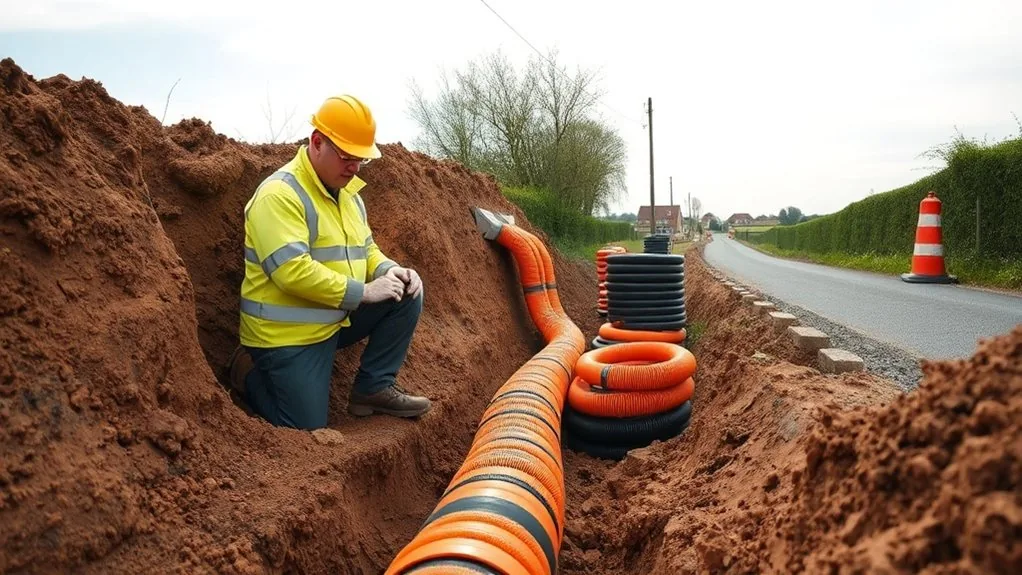
If you need electric ducting installation in Whitstable to ensure your power supply cables are mechanically protected, correctly segregated, and compliant with BS 7671, NJUG and utility standards, proper specification is essential.
This safeguards cables under driveways and access routes while allowing for future expansion such as EV chargers or outbuildings.
Call now for a fast quote or emergency callout in Whitstable.
Although it’s often confused with simple cable routing, electric ducting installation is the planned design and fitting of protective conduit systems that house and segregate electrical cables in compliance with wiring regulations. You’re providing a defined pathway that maintains mechanical protection, preserves cable insulation integrity, and supports correct circuit identification.
You’ll specify duct types, dimensions, and routes so they meet load, environment, and accessibility requirements. Attention to bend radii, fill capacity, and separation of low‑voltage, power, and data circuits is essential.
You must integrate safety protocols at every stage: evaluating fault levels, earthing, and bonding, and preventing overheating or abrasion. Properly installed ducting reduces electrical risks, simplifies maintenance, and ensures your installation aligns with BS 7671 and related Whitstable local authority standards.
You typically need electric ducting installation whenever electrical cabling must be protected, segregated, or future‑proofed beyond what basic clipping or surface trunking can safely provide. In Whitstable, you’ll usually look at buried or concealed ducting when you’re planning long cable runs, external supplies, or later expansion in line with BS 7671 and local authority requirements. It’s about combining safety precautions with practical cost considerations over the system’s lifespan.
You’re likely to need electric ducting installation when:
When you appoint a specialist for electric ducting installation in Whitstable, the work follows a defined sequence that’s governed by electrical and civil engineering standards. You’ll see this in a structured process: site survey and planning, trenching and duct laying, cable pulling with mechanical protection, and then testing and final terminations. Each stage is carried out with strict attention to safety, load capacity, and compliance with BS 7671 and relevant utility specifications.
Before any trench is dug or duct is laid, a structured site survey and planning phase guarantees the electric ducting installation in Whitstable complies with BS 7671, local authority requirements, and utility asset protection standards. You’ll have existing services mapped using utility records, CAT and Genny scanning, and visual inspections to define safe duct routes and separation distances.
You’ll also assess ground conditions, access constraints, and load requirements to size ducts correctly and plan compliant cable capacities, pull lengths, and drawpit locations. Safety protocols are built in from the outset, including traffic management, exclusion zones, and emergency arrangements. Pre-start equipment maintenance checks ensure all tools and plant are safe, calibrated, and suitable, so the subsequent installation phase proceeds efficiently and conformingly.
Although every project in Whitstable has unique constraints, the trenching and duct laying phase follows a tightly controlled sequence to protect existing assets and guarantee long-term cable integrity. You’ll start by confirming utility drawings, then set out the route, excavation width, and depth to comply with BS 7671 and local authority requirements, applying Trenching techniques appropriate to soil type and traffic loading.
Once the trench is stable, you’ll place bedding, install ducts to specified gradients, and maintain separation from gas, water, and telecoms. Duct laying methods must assure correct alignment, jointing, and identification.
| Stage | Key Focus | Compliance Aspect |
|---|---|---|
| Setting Out | Route, depth, clearances | Utility maps, local permits |
| Excavation | Safe Trenching techniques | Temporary works, shoring |
| Duct Placement | Accurate Duct laying methods | Spacing, markers, backfill |
Once ducts in Whitstable are proven clear, continuous, and correctly graded, the focus shifts to controlled cable pulling and protection to preserve insulation integrity and achieve full compliance with BS 7671 and DNO specifications. You’ll specify pulling tensions, sidewall pressure limits, and bend radii in line with manufacturer data, then use calibrated winches, swivels, and low-friction draw ropes to avoid torsion and sheath damage.
You’ll implement disciplined cable management by spacing pulls, labelling circuits, and maintaining separation from data or telecoms where required. For conduit protection, you’ll verify ducts are suitably rated, jointed, and sealed against moisture and contamination, with compliant end caps and marker tape. Throughout, you’ll document routes and as-laid positions to support future maintenance and upgrades.
When cable installation through the ducts in Whitstable is complete, the work progresses to systematic testing and controlled final connections to verify safety, compliance, and performance. You’ll see structured testing procedures carried out in line with BS 7671 and the Distribution Network Operator’s requirements. Insulation resistance, continuity, polarity, and earth fault loop impedance are measured and recorded, ensuring cables haven’t been damaged during pulling or jointing.
You then move to energisation planning and final connections. Terminations are torque-set, glands are earthed, and phase sequencing is confirmed before live connection. Protective devices and RCDs are tested under load conditions, with results logged for certification. Only when all readings fall within prescribed limits is the system signed off and put into service.
Before you specify an installation method for electric ducting in Whitstable, it’s essential to understand how modern duct installation techniques compare with traditional open-cut excavation regarding compliance, safety, and lifecycle performance. You’ll typically assess route constraints, existing utilities, ground conditions, and statutory undertaker requirements before deciding.
Traditional excavation gives full visual access but increases service strike risk if underground safety protocols, surveys, and CAT/Genny scanning aren’t rigorously applied. It also demands wider work zones and more temporary works to maintain public and workforce protection.
Modern trenchless options, such as directional drilling or moling, minimise surface disruption while still complying with BS 7671, NJUG guidelines, and DNO specification depths. However, they require accurate as-built records, controlled drilling profiles, and strict quality checks to confirm duct integrity and separation distances.
Selecting electric ducting as your core installation strategy in Whitstable doesn’t just influence construction methodology; it directly affects network resilience, safety compliance, and long-term asset value. Properly designed duct routes protect conductors from moisture, impact, and UV degradation, while also simplifying upgrades, diversions, and technology changes over the asset life.
You’re also future‑proofing for integration with wireless alternatives and solar powered solutions by providing defined, safeguarded pathways for power and control cabling.
Whether you’re upgrading a single dwelling or planning a multi‑unit commercial development in Whitstable, electric ducting provides a controlled, compliant route for LV and ELV cabling that’s aligned with BS 7671 and local authority requirements. You gain defined cable zones, mechanical protection, and clear separation between power, data, and control circuits.
In domestic settings, ducting future‑proofs EV chargers, PV arrays, battery storage and smart home controls, integrating with smart grid infrastructure and renewable energy technologies without disruptive re‑wiring. In commercial premises, it supports higher circuit densities, metering, emergency systems, and structured data networks, while maintaining segregation and fire‑safety performance. Properly specified ducting optimises load management, facilitates upgrades, and reduces fault risk across car parks, plant rooms, risers, and external service corridors.
How do you guarantee electric ducting is designed, installed, and certified correctly across Whitstable’s varied domestic and commercial sites? You start with a full site survey, evaluating load profiles, future expansion, and ground conditions so duct routes, depths, and segregation meet current safety regulations and manufacturers’ specifications.
We’ll plan your cable management to avoid thermal issues, interference, and mechanical damage, then install ducts with calibrated measurements, compliant bends, and marked draw pits for future access and testing.
| Phase | Technical Focus | Outcome |
|---|---|---|
| Design | Load, routing, coordination | Compliant duct specification |
| Installation | Depth, separation, mechanical support | Protected power infrastructure |
| Testing & Signing | Continuity, insulation, certification | Verifiable safety performance |
| Documentation | As-builts, labelling, schedules | Traceable cable management data |
You’re left with a robust, auditable ducting system across Whitstable.
Beyond delivering a compliant, documented ducting system, you need an installer in Whitstable who consistently applies the same engineering discipline on every project. You’re selecting a partner to protect your electrical infrastructure for decades, not just a contractor to lay pipes.
We follow strict Safety protocols aligned with BS 7671, CDM Regulations, and relevant utility specifications, from excavation to cable pull-back and final proving. Every design is calculated for capacity, segregation, and future expandability, then verified on-site.
You’ll get technically justified material options—uPVC, HDPE, twinwall, or specialist LV/HV-rated systems—selected against load, depth, ground conditions, and route risk. Our teams are fully trained, certified, and method-statement led, so each installation is controlled, traceable, and ready for inspection or adoption.
You’ll naturally want clear answers on how long electric ducting installation takes, whether it’s more cost‑effective than traditional trenching, and if your specific location in Whitstable is covered. In this section, we’ll address these points with reference to typical programme durations, cost drivers, and our current operational zones. Our responses are based on industry standards, safety regulations, and proven installation methodologies.
Typical electric ducting installations in Whitstable range from a few hours for short, straightforward runs to several days for complex, multi-service routes requiring road openings and coordination with utility providers. Your timescale’s influenced by duct length, ground conditions, existing utilities, and the level of reinstatement required. During quotation, an installer should provide a clear programme and, where relevant, a brief cost comparison for alternative routing options.
You’ll also need to factor in permitting and notice periods. Works in the public highway must comply with local authority requirements, traffic management rules, and safety regulations such as HSE guidance on excavation, cable installation, and confined spaces. Pre‑installation surveys, cable pulling, testing, and certification add time but guarantee compliance and long‑term system reliability.
Installation timeframes naturally lead to questions about cost, and many clients ask whether installing electric ducting in Whitstable works out cheaper than repeated open‑cut trenching. From a strict Cost comparison standpoint, you shouldn’t just look at the initial dig; you need to assess lifecycle expenditure.
With ducting, you invest once in correctly sized, BS EN-standard compliant ducts, marker tape, and access chambers. That infrastructure allows future cable upgrades or replacements without major re‑excavation, drastically reducing labour, reinstatement, and downtime.
Traditional digging for each new circuit seems cheaper upfront, but repeated trenching adds cumulative cost, service‑strike risk, and safety management overheads. As excavation alternatives, well‑designed electric ducting systems typically become more economical over the asset life, especially on sites expecting load growth or configuration changes.
Wondering whether our electric ducting installation team actually works in your part of Whitstable? Our area coverage spans all major towns and rural zones, subject to access constraints and network coordination. You’ll find our service availability across Ashford, Maidstone, Medway, Canterbury, Thanet, Swale, Tunbridge Wells, Tonbridge and Malling, Dartford, Gravesham, Dover, Folkestone and Hythe, and surrounding villages.
Before confirming a project, we verify local grid constraints, wayleave requirements, and any highways or street works permits. This ensures compliance with BS 7671, HSE guidance, and relevant Distribution Network Operator specifications. During your enquiry, we’ll assess load requirements, route feasibility, and ground conditions to confirm whether we can safely and efficiently serve your exact location within Whitstable.
Yes, existing underground services can and should be mapped before electric ducting installation. This is done using existing service maps, records from utility providers, and on-site detection methods such as CAT & Genny, ground-penetrating radar, and trial holes. Mapping helps reduce the risk of strikes, ensures correct duct routing, and maintains required clearances for a safe, compliant installation.
Electric ducting is affected by future driveway or garden landscaping changes because its routes must accommodate potential alterations in driveway levels, planting depths, and hardscape loads. You should specify appropriate depths and protective covers to prevent damage from excavation or heavy vehicles while ensuring compliance with BS 7671 and NJUG separation requirements from other services. Access points should be positioned discreetly to avoid conflicts with tree roots, and as-built drawings must be recorded for reference during future landscaping work.
Yes, eco-friendly materials for electric ducting systems are available, including HDPE ducts with recycled content that comply with BS EN 61386. Recycled ducting options include twin-wall or smooth-bore conduits made from post-consumer plastics, which meet necessary impact, crush, and dielectric strength requirements. It is important to check manufacturer certifications, UV stability, cable compatibility, correct installation depth, warning tape, and compliant markers for safety and regulatory compliance.
You need a formal wayleave or easement to install ducting across neighbouring land. Obtain written consent from the freeholder and any leaseholder, specifying the route, depth, and maintenance rights. Follow utility approval processes, including plans, cable-avoidance scans, and agreed reinstatement standards. For work on public highways, secure permits under the New Roads and Street Works Act and comply with BS 7671 and local authority requirements.
To locate electric ducting routes years after installation, start by reviewing as-built drawings and route planning records. Use a cable locator and signal generator to inspect the ducting and mark detected runs according to utility survey standards. If records are missing or accuracy is essential, arrange a PAS 128-compliant survey and update your documentation for future reference.
When you’re ready to move from planning to implementation, obtaining a detailed quote for electric ducting installation in Whitstable guarantees compliance with BS 7671, local authority requirements, and your project’s technical specifications. A structured quote lets you carry out a clear cost comparison while verifying that all materials, trenching methods, and cable routes meet relevant safety standards and DNO/IDNO requirements.
You’ll typically be asked for site plans, load calculations, proposed duct routes, and any constraints such as highways, shared driveways, or existing utilities. In return, you should expect a line-by-line breakdown covering duct specification, depth, marker tape, draw ropes, access chambers, and testing. Request written confirmation of certification, inspection regimes, and warranty terms so you can proceed confidently and safely.